
The Leviathan Spreadsheet
Part 3 of an exploration of the geopolitics of technology. We step back to recognize "the Machine" and its key architect.
Bygonepath
2/27/20266 min read
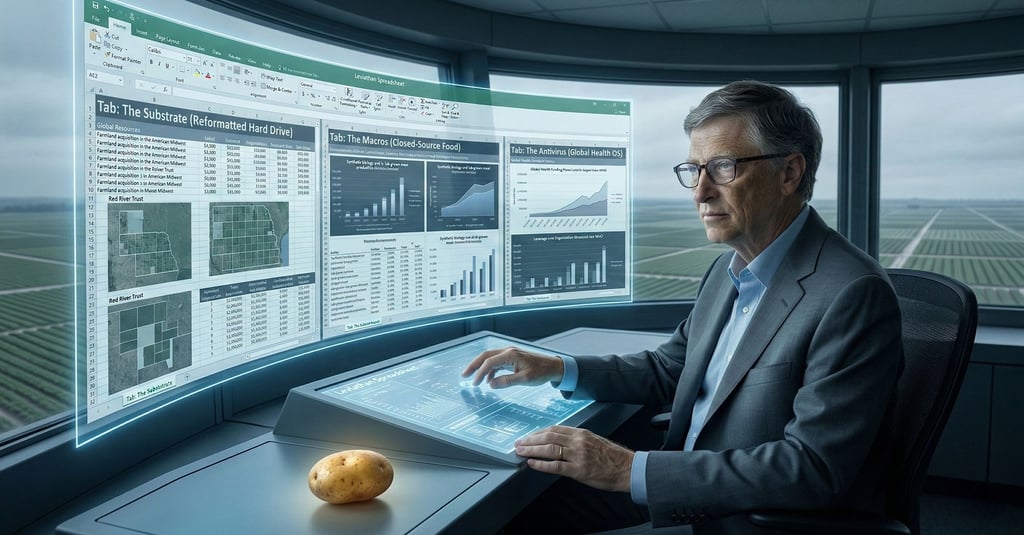
My last two articles could be summarized as a take-down of right-wing billionaire Peter Thiel and a response to his Dark Enlightenment philosophy explained with the mythology of Lord of the Rings. Today, we are going to look at Thiel’s philosophical adversary and mimetic rival, Bill Gates—the final boss of this trip down the rabbit hole. If Thiel is Saruman the White, Gates is the Dark Lord Sauron.
Grab some snacks and settle in, little hobbit. Pack another round of pipe-weed, my wizards. This is going to take a minute.
Earlier this week, February 24, 2026, Bill Gates held a town hall meeting at the Gates Foundation to address the controversy of his reported connection to Jeffery Epstein. Gates publicly admitted to having two extramarital affairs with Russian women while he was married to Melinda: a 20-something-year-old card player and an unknown “nuclear physicist." Gates's relationship with Epstein began in 2011—three years AFTER Epstein pleaded guilty to soliciting a minor for prostitution. Gates claims he took the meetings because Epstein promised to help raise massive amounts of money for global health from Wall Street billionaires. Gates admitted to flying on Epstein's private jet and spending time with him in New York, Washington, France, and Germany between 2011 and 2014. Epstein eventually found out about Gates's affairs and began blackmailing him. Gates categorically denied ever interacting with Epstein's victims. Gates told his staff, "I did nothing illicit. I saw nothing illicit."
Despite what consequences this might have for Gates personally, his foundation is presently announcing a historic $9 billion payout. This aggressive spending is part of a 20-year roadmap to entirely spend down the foundation's $200+ billion endowment and permanently close its doors by December 31, 2045. The final push is heavily focused on ending preventable death from disease.
On the climate front, a nuclear fusion company backed by Gates called Type One Energy hit a major milestone in January 2026. They submitted licensing applications to build an experimental commercial fusion reactor, “The Stellarator," on the site of a decommissioned coal plant in Tennessee, aiming to eventually replace fossil fuels with an artificial sun.
Gates is heavily funding the use of artificial intelligence in developing nations. His current projects include deploying AI to help smallholder farmers in Africa adapt to climate change by predicting weather and crop diseases and creating AI tools to assist healthcare workers in areas facing critical medical staff shortages.
He is the largest source of funding for the WHO and pushes for universal, standardized health regulations.
He advocates, and some would say dictates, global climate treaties and policy.
There is certainly a public agenda of taking the messy, divided world and putting it all onto a giant spreadsheet for corporate-funded organizations to optimize. Bill Gates is the physical avatar of the Antichrist that Peter Thiel and the New Right rages against. The globalist bureaucrat running a one-world government of peace and safety through regulation.
Hobbits and wizards everywhere can see what others cannot. Thiel vs Gates. Katechon vs Antichrist. It is a false choice. They are both separate sides of the same entity: “the Machine” that Tolkien referred to in his letters to friends. Mimetic Doubles wrestling for the advantage in the search for the One Ring.
Peter Thiel and Bill Gates pretend to be opposites. The Right-Wing Nationalist versus the Left-Wing Globalist. Yet, for all their superficial differences, both men are architects of a new form of totalitarianism, a philosophy perfectly captured by the 17th-century political theorist Thomas Hobbes.
In 1651, Hobbes argued in his masterpiece "Leviathan" that human beings, driven by competition in a chaotic "state of nature," must surrender their individual freedoms to an all-powerful, absolute sovereign—the Leviathan—in exchange for security. Before Hobbes, political authority was largely justified by the idea that monarchs were appointed by God. Hobbes stripped away the theology and argued that governments are created by human beings through a mutual agreement. While the Leviathan's power is absolute, it is not arbitrary. The Sovereign's entire legitimacy is conditional upon its ability to protect its subjects. If the Leviathan fails to keep the peace or tries to kill its own subjects, the agreement is broken, and the subjects have the right to defend themselves. It is absolute power, but strictly for the purpose of mutual survival.
Thus was born the "social contract."
To the Leviathan Spreadsheet, the Earth is not a living organism; it is a chaotic dataset that needs to be debugged, optimized, and brought under management. The dystopia Gates is marching us toward is silent, temperature-controlled, and smells of hand sanitizer. Thiel wants to rule you as a possible threat that must be suppressed. Gates wants to manage you as a liability that must be accounted for. The difference is academic, hence why they both hung out with Jeffery Epstein.
The architecture of this monstrous, sterile control system can be structured around the three foundational 'Tabs' of the Leviathan Spreadsheet:
Tab 1: The Substrate (Reformatting the Hard Drive)
To run a global operating system, you must own the motherboard. For Gates, the motherboard is the literal soil. Traditional, independent farming is an "open-source" mess that the Leviathan Spreadsheet cannot easily quantify. It has too many variables—weather, local markets, independent farmers.
This is why Bill Gates, a software magnate, is now the largest private farmland owner in the United States, quietly amassing roughly 242,000 to 250,000 acres of highly productive farm ground across nearly 20 states. He does not buy this land to be a farmer; he is buying it to reformat the hard drive of the American Midwest. He is taking the physical territory needed for our "Gardener's Hyperstition" and locking it behind a corporate paywall, ensuring that the substrate for autonomy is placed under the control of his central formula.
Tab 2: The Macros (Closing the Source Code of Food)
In a spreadsheet, a "macro" is a pre-programmed rule that automates a process so it performs identically every single time. Nature doesn't do this; nature is messy. To the Leviathan, this is unacceptable inefficiency.
This explains Gates’s massive investments in synthetic biology—a move to transition the human food supply from an open-source biological process to a closed-source intellectual property. He is a primary funder of companies like Beyond Meat, Impossible Foods, and Upside Foods which produces cultured chicken grown directly from animal stem cells in a lab. The goal is to replace the messy, autonomous "farm" with a centralized, patentable "factory" where food production is reliant on highly capitalized, proprietary technology. The Leviathan Spreadsheet cannot tolerate food it does not hold the patent for.
Tab 3: The Antivirus (Global Health as IT Support)
If the world is a spreadsheet, humans are the cells. Sometimes those cells get corrupted by a virus. What does a 1990s software monopolist do? He creates a mandatory, globally downloaded patch.
Gates's approach to global health mirrors a corporate takeover, where massive financial leverage translates to policy control. Now that Trump has withdrawn US funding, He is now the single largest source of funding for the World Health Organization (WHO). Between 2000 and 2024, the foundation made $5.5 billion in grants to the WHO, with the majority of the money highly earmarked, allowing Gates to largely dictate where it goes. Gates views human biology the same way he viewed Windows 95: it is his job to push out the "updates." The ultimate goal is not just health, but legibility. A vaccinated, digitally tracked, and standardized population is a population that perfectly fits into the rows and columns of the Leviathan Spreadsheet.
Peter Thiel looks at humanity and sees a ticking time bomb that needs an automated, militarized cage. Bill Gates looks at humanity and sees a disorganized Excel file that needs a macro. They both hang out on Epstein’s island because, like Hobbes’s sovereign, they believe the moral rules that govern the "little people" do not apply to the architects of the new state. Hobbes believed we surrendered our rights to a government in exchange for protection. Today, we are increasingly surrendering our data, our public squares, and our infrastructure to a couple of spoiled rich kids who invested in software in the 80’s in exchange for convenience and connectivity. The "Social Contract" is being replaced by their "Terms and Conditions."
Both men, in different ways, dilute the power of the everyday citizen. Under Gates' model, the most important decisions about global health and climate change aren't debated in parliaments; they are decided in the closed boardrooms of private foundations. Under Thiel's model, democratic debate is entirely eliminated in favor of a rigid, techno-authoritarian hierarchy where citizens are reduced to either shareholders or consumers of a privately owned state.
Ultimately, this leads to a fracturing of the state. As billionaires accumulate enough wealth and technological power to fund their own space programs, build private cities, or establish alternative currencies, the ultra-wealthy are no longer bound by the laws of the traditional state. They transcend it.
We are currently watching a tug-of-war: Will the traditional, democratic nation-states successfully regulate these “New Leviathans” or will the tech oligarchs successfully rewrite the social contract for the 21st century?
"The Gardener's Hyperstition" is the ultimate refutation of “the Machine.” Hobbes claims you cannot trust your neighbor, so you need a global overlord. The Hobbit and LotR claims you can trust your neighbor, provided you keep your community small, analog, and rooted in shared values.
Estel, my friends, in the next article we discuss solutions.